
By VOICES Staff.
America’s barges quietly sustain farmers’ ability to compete, and dominate, in global markets — a reality underscored by a new 2026 federal study on the economic importance of inland waterways to U.S. agriculture.
The report, prepared for the U.S. Department of Agriculture by the Department of Transportation’s Volpe Center, finds that the inland waterway transportation services industry supports more than 200,000 jobs nationwide and contributes nearly $30 billion annually to U.S. gross domestic product. Agricultural exports that depend on those waterways add another 123,000 jobs and roughly $17 billion in GDP, driven largely by American soybeans, corn and wheat shipped on barges.
Soybeans alone account for nearly 57,000 jobs and $11.7 billion in GDP when exported using inland waterways. Corn exports support more than 48,000 jobs and $4.3 billion in GDP, while wheat exports add nearly 16,000 jobs. These figures reflect not just farm production, but the broader web of transportation, processing and supporting industries that rely on U.S.-flagged river-based shipping.
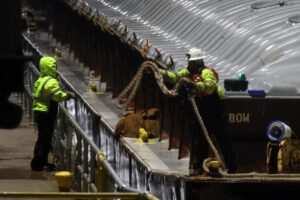
“When the river system works, farmers can compete globally, even in tight markets. The men and women of America’s tugboat, towboat and barge industry work hard to keep that supply chain moving safely and efficiently,” said Jennifer Carpenter, President and CEO of the American Waterways Operators.
A central theme of the study is reliability. Inland waterways offer a low-cost, high-capacity transportation option that allows U.S. producers to reach export markets efficiently, even when American crops are not the cheapest on the global market. That dependability — moving large volumes steadily and predictably — is repeatedly identified by the Volpe Center as a competitive advantage for U.S. agriculture.
Those economic benefits — cost efficiency, safety and resilience — are inseparable from a domestic transportation framework built around U.S. operators, maintained infrastructure and a stable workforce. That framework includes laws governing domestic shipping and dredging like the Jones Act and the Foreign Dredge Act, that help ensure rivers remain navigable and commercially viable year after year.
The Jones Act requires that vessels transporting goods between U.S. ports be American-built, owned, and crewed, sustaining a robust domestic maritime industry with highly skilled workers and well-maintained vessels.
Similarly, the Foreign Dredge Act ensures that dredging operations in U.S. waters are performed by American companies and equipment, keeping the specialized work of deepening channels and removing sediment in capable domestic hands.
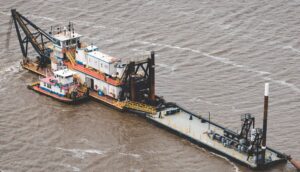
Together, these laws create a dependable system where the operators who rely on navigable waterways also possess the expertise and commitment to maintain them. This continuity delivers consistent maintenance schedules, deep local knowledge of challenging river conditions and a dedicated workforce invested in long-term infrastructure reliability.
The Volpe Center report identified that the Mississippi River carries the bulk of U.S. soybean exports, giving American farmers an advantage over competitors such as Brazil, where inland transportation has historically been more expensive. While production costs between the two countries are similar, the report finds that lower domestic transportation costs, thanks to mariners working on America’s armada of tugboats, towboats and barges have helped the United States maintain market share.
“That’s why policies that sustain a skilled American workforce, reliable vessels and consistent federal investment in our waterways are real, kitchen-table issues for farm families across the country,” said Carpenter.
Disruptions could be costly. The study estimates that diverting a single barge flotilla to truck or rail transportation can increase shipping costs by nearly $60,000, while also raising emissions and safety risks. Aging infrastructure compounds the risk of incidents, and deferred maintenance increases the likelihood of delays and closures.
America’s dredgers play a critical role in preventing those disruptions.
“Our dredges operate 24/7/365 on the Mississippi River system, at inland locks and dams, across the Great Lakes, and in deepwater ports — ensuring grain, fertilizer, fuel, and other essential agricultural inputs move efficiently to domestic markets and to global customers,” said William P. Doyle, CEO of the Dredging Contractors of America.
“Keeping these channels open and reliable is not just about exports; it’s about food security at home, economic competitiveness abroad, and the national security of the United States,” Doyle said.
The report also highlights the two-way nature of river commerce. Inland waterways do not just move crops downstream; they move fertilizer upstream. In many Midwestern states, waterways supply most or all of the nitrogen fertilizer used by farmers, helping contain input costs. According to the U.S. Army Corps of Engineers, 11.7 million tons of fertilizer were shipped from New Orleans and moved north on Jones Act-qualified barges in 2023. Without that upstream movement, production costs — and ultimately food prices — would rise.
Taken together, the findings reinforce a simple point: inland waterways are not just infrastructure. They are an economic system. Their continued performance depends on sustained investment, skilled workers, and the Jones Act and Foreign Dredge Act that keeps America’s rivers moving — quietly, efficiently and at scale.
Come Aboard
"*" indicates required fields