
By VOICES Staff.
Winter on the Great Lakes is not simply a seasonal challenge. It is an operational test for one of the most economically vital corridors in the United States. Each year, ice cover threatens the flow of commerce across a multibillion-dollar shipping system that moves roughly 130 million tons of cargo — including iron ore, coal, cement, steel, grain, sugar, and other essential commodities.
To meet this challenge, the U.S. Coast Guard must strategically deploy a limited fleet of icebreaking resources. In total, the Coast Guard operates nine icebreaking assets on the Great Lakes, including the heavy icebreaker Mackinaw and several smaller harbor tugs and buoy tenders capable of operating in thinner ice conditions.
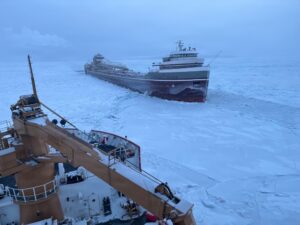
To help address this perennial operational challenge, the Michigan Office of Defense & Aerospace Innovation (ODAI) launched the MiSpace Hackathon 2025, bringing together more than 100 of Michigan’s top college students to develop fresh, mission-relevant solutions.
Rather than building abstract models, teams were tasked with creating a practical forecast tool that would depict the spatial field of ice across the Great Lakes over a four-day window (today plus the next three days). Each submission had to include not only the forecast itself but also clear narrative explanations and documentation of the data sources, modeling methods, and technological inputs that powered it.
One of the key issues identified by ODAI and Coast Guard partners is tied to how ice data is currently collected. The U.S. National Ice Center relies on Synthetic Aperture Radar (SAR) satellite data because it can observe ice through cloud cover and darkness.
However, SAR coverage on the Great Lakes is not available on demand, due to reliance on foreign-operated satellites. Current systems also lack consistent measurements of ice thickness and detailed ice characterization — information that would add significant value to icebreaking mission planning.
The winning team developed a predictive tool dubbed “IceScope GL” that combines National Ice Center datasets with weather forecasts and spatial analytics to give the U.S. Coast Guard greater lead time in positioning icebreaking assets and anticipating how ice fields may evolve.
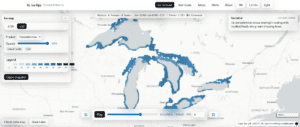
IceScope GL was designed and built by University of Michigan engineering and computer science students John Akladus, Joani Kaleshi, Vishnu Yadagani and Efaz Rahman, who translated complex geospatial inputs into a more operational, user-friendly interface for winter navigation.
According to Mark Ignash, Director, Strategic Initiatives & Ecosystem Development for the ODAI, this kind of predictive visibility is especially valuable in the Great Lakes’ most vulnerable corridors.
“Connecting channels like the Straits of Mackinac, the St. Marys River, and the St. Clair River serve as the narrow arteries of regional trade,” Ignash said. “Even a localized ice pack here can halt the flow of essential commodities like iron ore and coal.”
Shallow nearshore areas such as Saginaw Bay and the western end of Lake Erie, he noted, are particularly unpredictable and often freeze faster than open water. Earlier insight into these high-risk zones can help keep critical transit lanes open longer into the winter season.
Ignash emphasized that a four-day predictive window fundamentally changes how winter operations are managed.
“With 96 hours of lead time, a 1,000-foot laker carrying iron ore to a steel mill can sync its departure or adjust its speed to meet an icebreaking escort exactly when needed. This turns a high-stakes guessing game into a scheduled, efficient operation.”
Industry leaders welcomed the promise of IceScope GL and other projects submitted for the Hackathon.
“The tool could be helpful for prepositioning federal icebreaking assets to assist Jones Act vessels,” said Eric Peace, Spokesperson for the Lake Carriers Association.
At the same time, LCA stressed that forecasting cannot substitute for capacity on the water.
“No matter how much you can predict ice, if assets aren’t available or are otherwise engaged somewhere other than where the commercial vessel is stuck… it becomes pointless,” said Peace.
With only a handful of icebreaking assets available and limited coordination with Canadian Coast Guard officials, every additional day of predictive awareness matters. That’s why maritime stakeholders have long argued that the U.S. Coast Guard needs to increase its investments in the Great Lakes region.
“The Coast Guard has historically underinvested in the Great Lakes and the Jones Act fleet,” Peace said. “LCA has been pushing for years to build another heavy Great Lakes icebreaker and to recapitalize the over 40-year-old icebreaking tugs.”
Ignash echoed that message, stressing that technology is a force multiplier — but not a replacement.
“The Great Lakes rely heavily on the USCGC Mackinaw, known as ‘The Mighty Mac,’ … The algorithms give us the brainpower to work smarter, but we still need the horsepower of modern, reliable icebreakers to execute the mission.”
Despite Congressional “plus-ups” exceeding $100 million for a heavy icebreaker, LCA warns that progress has been slow, and recent federal funding packages have not delivered immediate relief for the Great Lakes.
The MiSpace Hackathon is a powerful reminder that American maritime dominance is built not only in shipyards but also in classrooms. Student teams can solve real problems for national security and economic continuity in support of the men and women of our maritime industry.
The Coast Guard will need every tool available—advanced forecasting, modernized assets, and sustained commitment—to keep commerce moving.
The Michigan Office of Defense & Aerospace Innovation is showing next generation is already stepping up. And as the Lake Carriers’ Association pledged
“The Lake Carriers’ Association will continue to work to protect America’s Fourth Sea Coast from crippling winter weather and ice conditions which hamper the delivery of critical raw materials for steel making, road construction, power generation, and many other basic human needs,” said Peace.
Innovation matters. Investment matters. And on the Great Lakes each winter, ensuring American commerce can move through ice remains as essential as ever.
Come Aboard
"*" indicates required fields